
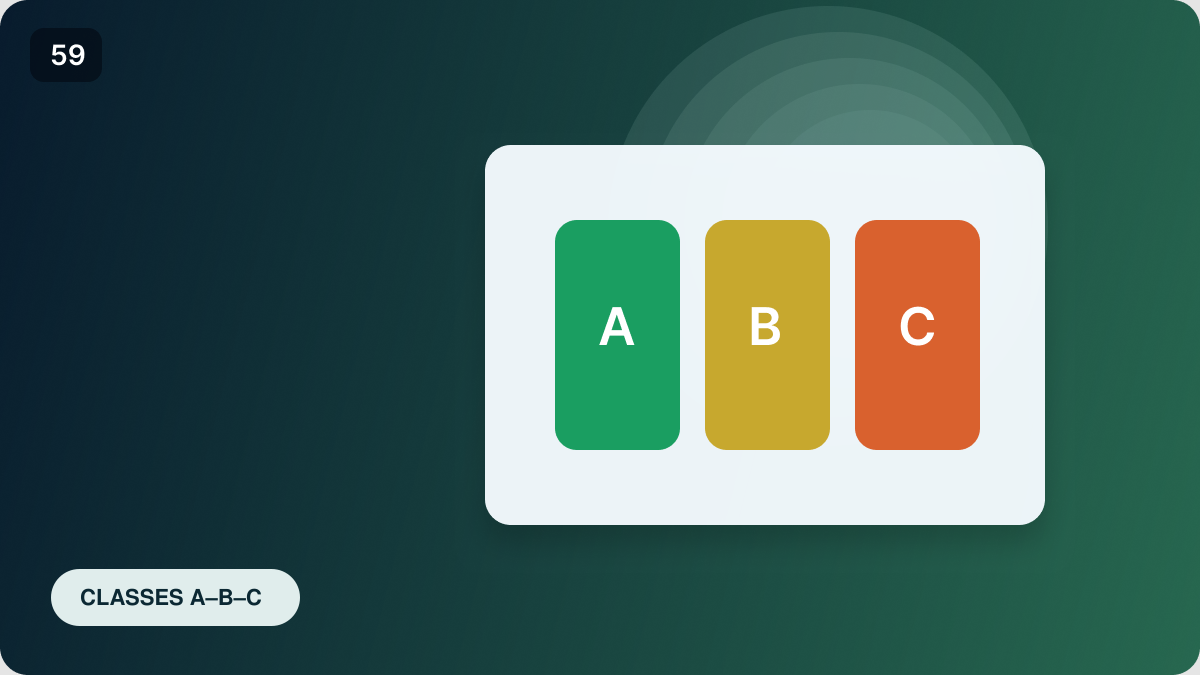
A RecyClass class is not a recycled-content percentage or a guarantee that every pack will actually be recycled. Classes A, B and C describe different design outcomes. A self-assessment result, a certified class and a PPWR performance grade must be distinguished.
Does class A mean 100% recyclability, and does class C mean a poor-quality pack?
It is not that simple. RecyClass classes describe how packaging design affects sorting, material losses and the quality of the resulting recyclate. A is the highest class, while B and C are also recognised as recyclable outcomes under the current RecyClass methodology. Always read the result together with the report and the assessment scope.
1. The current RecyClass system uses classes A, B and C
The methodology update in 2025 simplified the classification system. The former classes D, E and F were removed. Packaging now receives class A, B or C, or the result “not recyclable”.
This change matters when comparing older reports, presentations and marketing materials with a current tool result or certification outcome.
2. Class A: the highest result in the RecyClass system
Class A means that the packaging does not present recyclability issues for the assessed system. The resulting material can potentially return to an application of the same quality, including through a closed loop.
This does not guarantee that every individual pack will be recycled. Actual recycling still depends on collection, consumer behaviour and the infrastructure available.
3. Class B: minor issues, with good recycling potential
Class B indicates some design issues that slightly affect the quality of the recovered material. Most of that material can still potentially be used in a closed loop.
In practice, the design may fit the recycling stream well while being less optimised than a class A solution.
4. Class C: recyclable packaging with a design compromise
Class C indicates recyclability issues that affect recyclate quality or cause material losses during recycling.
Depending on the cause, the material may be suitable for cascade applications, or part of the potential feedstock may be lost while the recovered material remains suitable for a closed loop. Class C therefore provides a reason to examine opportunities for further design improvement.
5. “Not recyclable” is different from a positive A–C class
A “not recyclable” result may arise from significant design issues, substantial losses, a lack of suitable infrastructure or failure to satisfy the methodology's eligibility conditions.
It should not be softened into a neutral description such as “a low class”. It is a different outcome from classes A, B and C.
6. The class relates to the whole packaging design
The assessment is not limited to the main polymer. Labels, sleeves, closures, adhesives, printing, barriers, additives and product residues can all affect the class.
One problematic component can lower the result for the complete design if it causes significant material losses or reduces recyclate quality.
7. The class is not a recycled-content percentage
Class A, B or C does not tell the reader how much post-consumer recycled material, or PCR, the pack contains. A class A pack may use virgin plastic, while a pack with a high recycled content may receive class B, class C or a negative result.
Recycled content and recyclability need separate documentation.
8. Distinguish the Online Tool result from certification
The Online Tool can indicate a potential class based on self-assessment. A certificate results from an independent process carried out by a recognised Certification Body.
A self-assessed class must therefore not be communicated as a certified class.
9. RecyClass A–C does not automatically mean PPWR A–C
The PPWR also provides for grades A, B and C, but its legal system has its own criteria, thresholds and implementing framework, including delegated acts. Its Design for Recycling performance grades use thresholds of 95%, 80% and 70%.
The same letters do not establish automatic equivalence between a RecyClass result and the applicable legal PPWR grade. The relevant legal criteria and assessment requirements must be checked separately.
10. Link the class to a defined version of the design
Changes to a label, sleeve, adhesive, colour, layer, closure or other component may change the result. A certified class therefore refers to the particular configuration described in the documentation.
When making a change, check whether the design remains within the certificate's scope or the approved group of equivalent packaging.
11. The report explains more than the letter alone
A letter does not identify which component lowered the result or where material losses occur. For a packaging designer, the report and its explanation of specific issues are more useful.
They help establish whether a simple component adjustment is sufficient or a more substantial redesign is needed.
12. How to read a class in practice
First check the assessed product and design version, the recycling stream, the geographical scope, the methodology version, and whether the result comes from self-assessment or certification.
Only then does A, B or C become useful technical information rather than an isolated marketing shorthand.
Frequently asked questions
Does class C mean the packaging is not recyclable?
No. Under the current RecyClass methodology, A, B and C are positive classes. Class C nevertheless identifies issues affecting material quality or recovery that should be examined for improvement.
Does RecyClass still use classes D, E and F?
Not in the current system. They were removed in the methodology update introduced in 2025.
Does RecyClass class A mean PPWR grade A?
This cannot be assumed automatically. The two systems have different assessment bases, and PPWR compliance requires its own conformity assessment.
Do I keep the same class after changing a label?
Only if the change does not affect the result and remains within the approved scope. Where necessary, notify the change and have it assessed.